
The hydraulic hose outer cover — what's actually around that hose?
The outer cover of a hydraulic hose largely determines how long it lasts in real-world use. Learn the difference between CR, HARC and UHMWPE covers and how to choose the right one for your application.
When buying hydraulic hoses, most people focus on pressure rating, reinforcement type and fittings. Understandably so. But the outer cover — the outermost rubber layer — deserves more attention than it usually gets. It largely determines how long a hose holds up in practice, and the wrong choice can cause a hose that is perfectly suited to the pressure and fluid to fail prematurely.
What does the outer cover do?
The outer cover protects everything beneath it: the reinforcement layers and the inner tube. It is the first line of defence against abrasion, external chemical attack, UV radiation, ozone and mechanical damage. A damaged cover exposes the wire reinforcement to moisture and corrosion, undermining the hose's pressure resistance — even if nothing is wrong on the inside.
One important distinction: the outer cover does not come into contact with the hydraulic fluid. That is the job of the inner tube. Cover selection therefore depends entirely on the external environment: abrasion, chemicals, temperature, UV exposure and fire risk.
Standard rubber cover (CR / Neoprene)
For most industrial hydraulic hoses, neoprene (chloroprene rubber, CR) is the baseline. CR combines good abrasion resistance, inherently flame-retardant properties, and solid resistance to ozone and weathering across a range of -40°C to +130°C. It is the industry standard for a reason: reliably fit for the vast majority of applications.
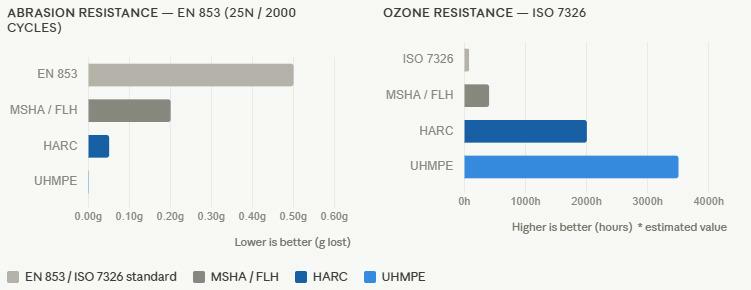
All Intertraco hoses — both braided and spiral — are MSHA certified. That certificate from the American Mine Safety and Health Administration guarantees flame retardancy and an abrasion and ozone profile that significantly exceeds EN/ISO norms. In the EN 853 abrasion test, an MSHA cover loses 0.20 g against the standard limit of 0.50 g. Ozone resistance stands at 400 hours against the ISO norm of 72 hours.
For applications where a smooth outer surface is preferred — for ease of cleaning or aesthetic reasons — we offer the SK216S, a hose with a smooth CR cover.
HARC cover (High Abrasion Resistant Cover)
In environments with intense mechanical stress, a standard cover does not last long. The HARC cover is an optimised rubber compound with increased cross-linking at molecular level, resulting in dramatically improved abrasion resistance. HARC is the standard cover on all spiral hoses and is also available on certain braided hoses, including the SK216-L.
The numbers speak for themselves: where a standard MSHA cover loses 0.20 g in the EN 853 abrasion test, a HARC cover loses just 0.05 g. Ozone resistance rises to 2,000 hours. The HARC cover is also rated for low-temperature environments down to -50°C — relevant for refrigeration systems, offshore applications and mountain environments.
Typical applications: forestry, mining, earthmoving equipment, marine installations, hydraulics in environments with intensive contact with rough surfaces.
Double-layer UHMWPE cover
The UHMWPE cover goes a step further: a double-layer construction combining a conventional outer rubber layer with a UHMWPE film (ultra-high molecular weight polyethylene). UHMWPE has one of the highest abrasion resistances of any polymer, combined with a low coefficient of friction — the hose tends to slide over surfaces rather than wear against them.
In the EN 853 abrasion test, the UHMWPE cover records a loss of 0.00 g. Ozone resistance reaches 3,500 hours. The combination of rubber and UHMWPE film also provides exceptional UV resistance, making this cover particularly well suited to outdoor applications with prolonged sun exposure. The values for HARC and UHMWPE are based on extrapolated test results.
Our SK216-P is the hose with UHMWPE cover.
Typical applications: extreme abrasion combined with UV exposure, offshore, outdoor installations, environments where hoses regularly move across sharp edges or structures.
Performance by the number
How do you choose?
The choice comes down to three factors: the external environment (UV, ozone, chemicals), the mechanical load (abrasion, impact) and temperature extremes.
As a rule of thumb: for standard industrial hydraulics in a protected environment, an MSHA-certified CR cover is sufficient. If the hose is used outdoors, in forestry or mining, or runs regularly against rough metal, HARC is the right choice. For extreme abrasion combined with UV exposure or intensive outdoor applications, the UHMWPE cover is the most robust option.
Not sure which cover is right for your installation? Contact us — we'll help you match the full hose construction to your specific environment.