
How to Read the Markings on a Hydraulic Hose
Learn how to decode the numbers, letters and abbreviations printed on hydraulic hoses: inner diameter, working pressure, certifications and hose standards. Explained with a real Bridgestone 4ST+ example.
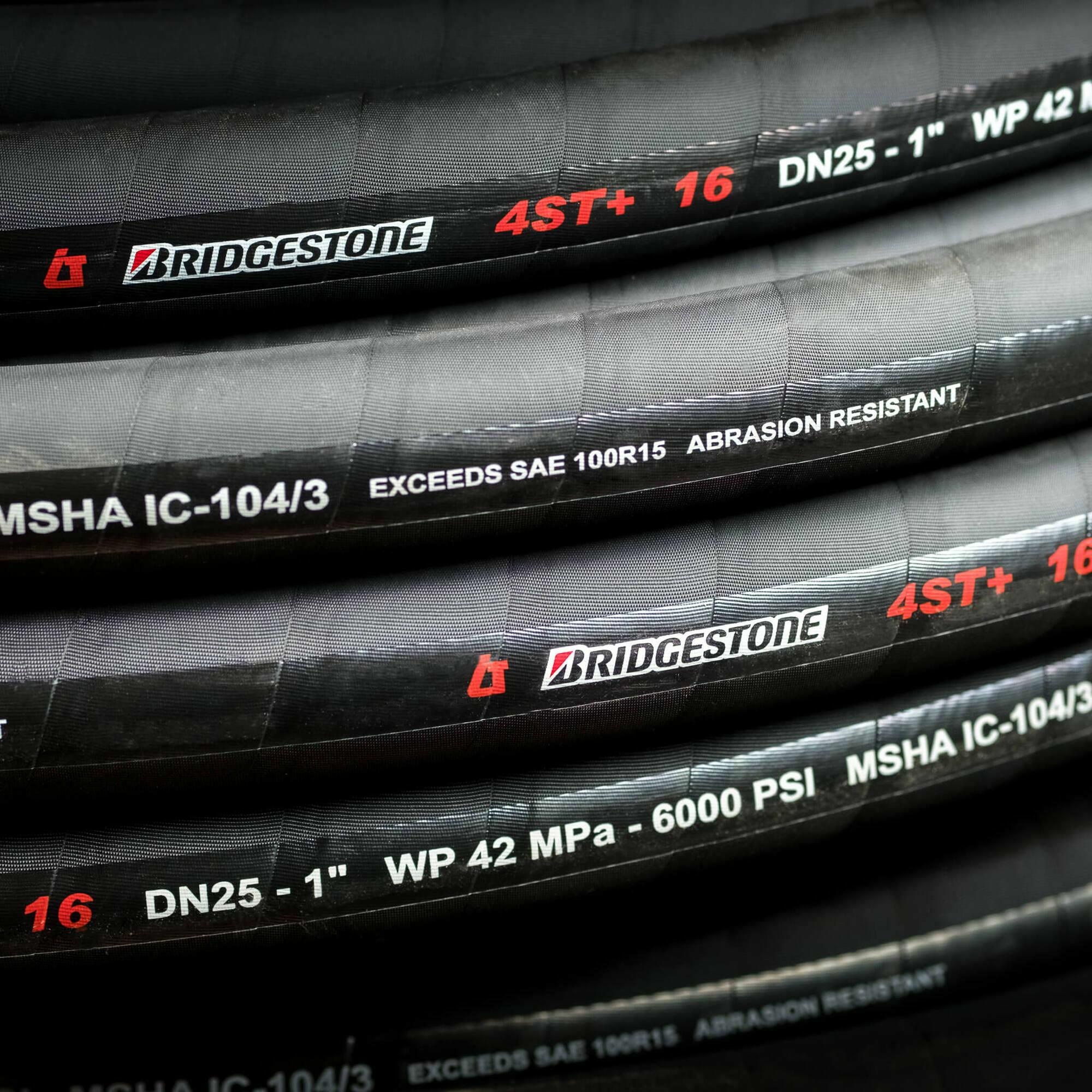
Every hydraulic hose carries a string of numbers, letters and abbreviations. To the untrained eye, it looks like a jumble of technical codes. But once you know what to look for, you can read the full specification of a hose at a glance. Here's how to decode a real-world example.
Brand and distributor
Most hoses display both the manufacturer's logo and that of the official distributor. In this case, Bridgestone is the manufacturer and Intertraco is the official European distributor. Van de Calseyde is the official Belgian distributor for Intertraco and carries the full Bridgestone range.
4ST+ — the hose type
The number before "ST" indicates the number of steel reinforcement layers. These layers are either braided or spiral-wound:
Types with 1, 2 or 3 layers are typically braided. Braided construction is more flexible and easier to route, but is suited to lower working pressures. Types with 4 or 6 layers are spiral-wound. Spiral construction is stiffer but handles significantly higher pressures. The 4ST+ is therefore a hose with 4 spiral steel layers, built for demanding hydraulic applications.
Inner diameter: three notations for the same measurement
The inner diameter appears in three different formats on the same hose:
"16" is the SAE dash size (a dimensional code, not a millimetre value). DN25 is the metric designation in millimetres. 1" is the measurement in inches.
A conversion chart makes it easy to cross-reference these three notations. Feel free to request one from us.

WP — working pressure in three units
WP stands for Working Pressure, the maximum pressure the hose is designed to handle continuously. It is expressed in three ways:
42 MPa (megapascal) equals 420 bar, since 1 MPa = 10 bar. 6000 PSI stands for Pounds per Square Inch, the unit commonly used in Anglo-American markets.
All hydraulic hoses are rated with a safety factor of 4. This means the burst pressure is at least 4 times the working pressure — in this case, a minimum of 1680 bar.
MSHA IC-104/3 — safety certification
MSHA stands for Mine Safety and Health Administration, a US regulatory body that certifies equipment used in mining environments. A hose bearing this mark has passed rigorous flame and pressure tests and is approved for use in hazardous environments.
Exceeds SAE 100R15 — above the standard
The SAE 100R15 specification, issued by the Society of Automotive Engineers, covers hydraulic hoses designed for extremely high pressure and high impulse resistance: continuous operation at 42 MPa, with 4 or 6 spiral layers of high-tensile steel wire and an abrasion-resistant outer cover. "Exceeds" means this hose outperforms that standard in both pressure resistance and service life.
Abrasion resistant — reinforced outer cover
The outer layer of the hose is made from a specially compounded rubber that resists wear better than a standard cover. This matters most in environments where the hose rubs against rough surfaces, runs along sharp edges or is exposed to harsh outdoor conditions.
Conclusion
Next time you need to replace or reorder a hose, you don't have to guess. The markings tell you exactly what you're holding: the type, the size, the working pressure, the applicable standard and any special properties. Still not sure? Our team is happy to help you identify and select the right hose.